
You have probably heard it in a briefing or seen it on a union flyer: police officers live 22 years less than everyone else. It is one of the most repeated statistics in law enforcement, and unlike a lot of numbers that circulate in the profession, this one traces back to real peer-reviewed research. It also gets quoted without the context that makes it meaningful. If you lead a department, you deserve to know exactly where the figure comes from, what it does and does not prove, and what the wider body of research says about how officers actually die. Here is the accurate version.
DISCLAIMER: This is general information, not legal advice. NDS Wellness is a healthcare provider, not a law firm. Whether any specific obligation applies to your workforce depends on your industry, exposures, and jurisdiction, and should be confirmed with your safety team and employment counsel.
Key Insights
- The 22-year figure is real and traceable: It comes from a 2013 peer-reviewed study by Violanti and colleagues, which found a mean life expectancy difference of 21.9 years between Buffalo, New York police officers and the general US male population.
- It is one cohort, not a national average: The study followed male officers from a single city over several decades, and the statistical range ran from roughly 14 to 29 years, so the precise “22” should be read as a finding, not a fixed national number.
- The wider research agrees on the direction: Multiple studies across decades have found elevated all-cause and cardiovascular mortality among officers compared with the general population.
- Cardiac risk spikes during specific duties: A Harvard study published in the BMJ found sudden cardiac death risk was 34 to 69 times higher during restraints and altercations than during routine duty.
- The mechanism points straight at screening: Stress, shift work, and cardiovascular strain build quietly over a career, which makes regular cardiac-focused screening the most practical intervention a department controls.
Where the 22-Year Number Comes From
Unlike many statistics that circulate in the fire and police services, this one has a clear origin. Knowing the study behind it lets you use the number with confidence and defend it when someone asks.
The Violanti Study
In 2013, John M. Violanti of the University at Buffalo, working with researchers from the Centers for Disease Control and Prevention, published a life expectancy analysis in the International Journal of Emergency Mental Health. The team examined male police officers in Buffalo, New York who served at least five years on the force between 1950 and 2005, then compared their life expectancy with the general US male population using life table methods.
What the Researchers Found
On average, officers in the sample had a life expectancy 21.9 years lower than the comparison population, with a 95 percent confidence interval of 14.5 to 29.3 years. The researchers also found that years of potential life lost among officers was roughly 21 times greater than in the general population, and that the gap was more pronounced in younger age groups. In one striking comparison, a male officer aged 50 to 54 had close to a 40 percent probability of death, against roughly 1 percent for men of the same age in the general population.
What the Number Does and Does Not Say
This is where most retellings of the statistic go wrong. The finding is serious and worth acting on, but it is not the same as saying every officer in America loses 22 years of life.
One City, One Group of Officers
The study followed male officers in a single city across a specific historical period. It did not measure every department in the country, and it did not include women or a broad multi-agency sample. That does not invalidate the finding. It does mean the honest framing is “research on this cohort found a gap of about 22 years,” not “every officer dies 22 years early.”
Why the Range Matters
The confidence interval ran from about 14 to 29 years, which is a wide band. When you cite the number, citing it as a research finding with a range attached is both more accurate and more persuasive, particularly with a city council or a benefits committee that will check your sources. The researchers themselves acknowledged that debate over police life expectancy has continued in the field.
The Wider Mortality Research Points the Same Direction
The 22-year figure is the headline, but it is not the only evidence. Several decades of research point consistently toward elevated mortality risk in policing.
Elevated Death Rates Across Decades
An earlier analysis by Violanti and colleagues of a 40-year cohort of Buffalo officers found all-cause mortality significantly higher than the general population, with elevated deaths from arteriosclerotic heart disease among officers with 10 to 19 years of service. A later assessment covering police deaths from 1950 through 2018 again found deaths from circulatory system disease elevated among officers with longer service time.
The Career Effect
One pattern across this research deserves attention from anyone running a department. People who enter police work generally start as a healthy population, screened and fit at hire. The research suggests they deteriorate physically and psychologically as years of service accumulate. In other words, the risk is not something officers bring to the job. It is something the career appears to build.
Where Cardiac Risk Actually Concentrates
If mortality research tells you officers die earlier, cardiac research tells you when the danger peaks. The findings are specific enough to be useful.
34 to 69 Times Higher Risk During Restraints
A study led by researchers at the Harvard School of Public Health, published in the BMJ in 2014, examined 441 sudden cardiac deaths among US law enforcement officers. Compared with routine and non-emergency activities, the risk of sudden cardiac death was 34 to 69 times higher during restraints and altercations, 32 to 51 times higher during pursuits, 20 to 23 times higher during physical training, and 6 to 9 times higher during medical and rescue operations.
The Time Mismatch
The most revealing part of that study is the mismatch between time and risk. Routine duties account for roughly 75 percent of an officer’s working time, yet 77 percent of sudden cardiac deaths occurred during non-routine activity. Restraints and altercations make up an estimated 1 to 2 percent of an officer’s annual time on the job, but accounted for about 25 percent of on-duty sudden cardiac deaths.
What That Means for Prevention
An officer does not develop heart disease during a foot pursuit. The pursuit is the trigger. The underlying cardiovascular condition was already there, usually undetected, which is exactly the kind of problem screening exists to find.
Why Officers Carry This Risk
The research points to a combination of factors rather than a single cause, and most of them are cumulative rather than dramatic.
- Chronic stress: Sustained exposure to high-stress incidents and the physiological load that comes with it.
- Shift work: Rotating and overnight schedules that disrupt sleep and metabolic function.
- Weight and fitness: Research has found higher body mass index among officers than in comparable non-police working populations.
- Environmental exposures: Time spent in traffic, at scenes, and around hazardous substances over a full career.
Every one of these builds slowly and silently, which is why officers so often feel fine right up until something goes wrong.
What Departments Can Actually Do
You cannot remove stress or shift work from policing. You can change how early a problem gets caught, and that is the variable that moves outcomes.
Screening Built for Cardiac Risk
A standard annual physical was never designed for this risk profile. Given how concentrated cardiovascular danger is in this profession, a screening program built around cardiac evaluation, including EKG, stress testing, and echocardiogram, is far better matched to what the research shows actually threatens officers.
Removing the Barriers to Getting Checked
The screening that gets skipped is the one that requires a day off, a drive across town, and a waiting room. Bringing screening to the department, across every watch, is the most reliable way to make sure the whole roster gets checked rather than only the officers who happen to find the time.
How NDS Wellness Screens Police Officers
NDS Wellness built its police health and wellness program around exactly the risks this research identifies. Officers get a real physician appointment on-site, not a finger-prick at a folding table, including comprehensive blood work and a full cardiovascular workup with a 12-lead EKG, stress testing, and echocardiogram. Every screening also includes a confidential behavioral health review, because the stress load documented in the research does not only affect the heart.
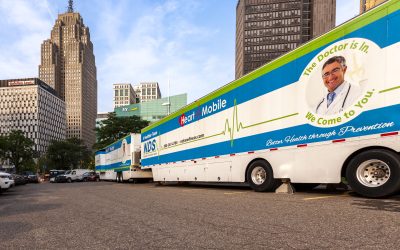
Results are explained by a physician and follow-up care is coordinated, so a concerning finding becomes a clear next step rather than a dead end. Because we arrive in a mobile wellness clinic, your department can screen across every watch without pulling officers off the street, and results stay confidential between the officer and the clinician.
Sources
- Violanti JM, Fekedulegn D, Hartley TA, Andrew ME, Gu JK, Burchfiel CM. “Life Expectancy in Police Officers: A Comparison with the U.S. General Population.” International Journal of Emergency Mental Health, 2013;15(4):217-228: pmc.ncbi.nlm.nih.gov/articles/PMC4734369/
- Varvarigou V, Farioli A, Korre M, Sato S, Dahabreh IJ, Kales SN. “Law enforcement duties and sudden cardiac death among police officers in United States: case distribution study.” BMJ, 2014;349:g6534 (Harvard School of Public Health): pubmed.ncbi.nlm.nih.gov/25406189/
- Violanti JM, et al. “Dying for the job: police mortality, 1950-2018”: pmc.ncbi.nlm.nih.gov/articles/PMC10191188/
- Centers for Disease Control and Prevention (CDC) / NIOSH document archive, life expectancy in police officers: stacks.cdc.gov/view/cdc/200459
- Harvard School of Public Health, “Police at higher risk of sudden cardiac death during stressful duties”: news.harvard.edu/gazette