VO2 max is the single best measure of how much work your cardiovascular system can actually do, and for police officers it is more than a fitness statistic. The research on officer deaths shows cardiac events cluster around moments of sudden maximal exertion, the restraint, the foot pursuit, the fight that starts without warning. VO2 max measures precisely the capacity those moments demand. Below is a chart of published reference values by age and sex, an explanation of how to read your number, and why this measurement belongs in a law enforcement screening program rather than only in an athlete’s training log.
DISCLAIMER: This is general information, not legal advice. NDS Wellness is a healthcare provider, not a law firm. Whether any specific obligation applies to your workforce depends on your industry, exposures, and jurisdiction, and should be confirmed with your safety team and employment counsel.
Key Insights
- VO2 max is your body’s maximum oxygen uptake: It reflects how much oxygen your heart, lungs, and muscles can use at peak effort, measured in milliliters of oxygen per kilogram of body weight per minute.
- The reference numbers below come from real US testing data: The FRIEND registry published percentile values from 7,783 maximal treadmill tests conducted at eight US laboratories, which remains the best modern American reference standard.
- Fitness declines about 10 percent per decade: FRIEND researchers measured a decline of roughly 9 percent per decade in men and 10 percent in women, which is why any chart has to be read by age.
- Low fitness is a powerful mortality predictor: Research cited by the FRIEND authors associates low cardiorespiratory fitness with a two to five-fold increase in cardiovascular and all-cause mortality, independent of other risk factors.
- For officers, the number has an operational meaning: Sudden cardiac death risk rises 34 to 69 times during restraints and altercations compared with routine duty, which makes capacity for sudden exertion a genuine occupational concern.
What VO2 Max Actually Measures
VO2 max, or maximal oxygen uptake, is the highest rate at which your body can take in and use oxygen during intense exercise. It is expressed in milliliters of oxygen per kilogram of body weight per minute, written as mL/kg/min.
Why It Is the Benchmark
Almost every part of the cardiovascular chain contributes to the number: how much blood your heart pumps per beat, how well your lungs transfer oxygen, how efficiently your blood carries it, and how effectively your muscles extract it. That is why a single figure tells you so much. The researchers behind the FRIEND registry noted that cardiorespiratory fitness has proven a more powerful predictor of adverse outcomes than traditional risk factors including hypertension, lipid abnormalities, smoking, physical inactivity, obesity, and diabetes.
METs, the Other Unit You Will See
Exercise reports often express the same capacity in METs, or metabolic equivalents. One MET equals 3.5 mL/kg/min, the approximate oxygen cost of sitting quietly. A VO2 max of 35 mL/kg/min is therefore about 10 METs. The conversion matters because occupational standards and stress test reports frequently use METs instead.
VO2 Max Chart by Age and Sex
The values below are percentile reference standards from the Fitness Registry and the Importance of Exercise National Database (FRIEND), published in Mayo Clinic Proceedings. They come from 7,783 maximal treadmill tests with direct gas analysis, performed on adults aged 20 to 79 without known cardiovascular disease. All values are in mL/kg/min.
VO2 Max Reference Values for Men
| Age | 25th percentile | 50th percentile (median) | 75th percentile | 90th percentile |
|---|---|---|---|---|
| 20-29 | 40.1 | 48.0 | 55.2 | 61.8 |
| 30-39 | 35.9 | 42.4 | 49.2 | 56.5 |
| 40-49 | 31.9 | 37.8 | 45.0 | 52.1 |
| 50-59 | 27.1 | 32.6 | 39.7 | 45.6 |
| 60-69 | 23.7 | 28.2 | 34.5 | 40.3 |
| 70-79 | 20.4 | 24.4 | 30.4 | 36.6 |
VO2 Max Reference Values for Women
| Age | 25th percentile | 50th percentile (median) | 75th percentile | 90th percentile |
|---|---|---|---|---|
| 20-29 | 30.5 | 37.6 | 44.7 | 51.3 |
| 30-39 | 25.3 | 30.2 | 36.1 | 41.4 |
| 40-49 | 22.1 | 26.7 | 32.4 | 38.4 |
| 50-59 | 19.9 | 23.4 | 27.6 | 32.0 |
| 60-69 | 17.2 | 20.0 | 23.8 | 27.0 |
| 70-79 | 15.6 | 18.3 | 20.8 | 23.1 |
How to Read the Chart
Find your age row, then locate where your number falls across the columns. Sitting at the 50th percentile means you are at the median for your age and sex. Above the 75th percentile is strong. Below the 25th percentile places you in the range where research has consistently found elevated health risk. Men test roughly 27 percent higher than women on average, a difference driven by hemoglobin concentration, heart size relative to body weight, and lean mass, which is why the two charts are separate.
Why This Number Matters More for Officers
For most people, VO2 max is a general health indicator. In law enforcement, it maps directly onto the physical reality of the job.
The Sudden Exertion Problem
Police work is long stretches of low activity punctuated by moments of maximum effort with no warm-up. An officer can go from sitting in a vehicle to sprinting or wrestling within seconds, under acute psychological stress, with adrenaline already surging. Cardiovascular capacity determines how much reserve is available when that transition happens.
What the Cardiac Death Research Shows
A study led by Harvard School of Public Health researchers, published in the BMJ, examined 441 sudden cardiac deaths among US law enforcement officers. Compared with routine duty, the risk of sudden cardiac death was 34 to 69 times higher during restraints and altercations, 32 to 51 times higher during pursuits, and 20 to 23 times higher during physical training. Restraints and altercations account for an estimated 1 to 2 percent of an officer’s annual working time but roughly 25 percent of on-duty sudden cardiac deaths.
Connecting the Two
Those events do not create heart disease. They expose it. Cardiac capacity and the underlying condition of the coronary arteries determine whether an officer handles that surge or is overwhelmed by it, which is exactly why measuring capacity and screening for disease belong in the same appointment.
What VO2 Max Predicts About Long-Term Health
The value of the measurement extends well past any single shift, which is why major health bodies have pushed to treat it as a clinical measure rather than a sports statistic.
The evidence cited by FRIEND researchers is striking on both ends. Low cardiorespiratory fitness, typically defined as the lowest quartile or quintile on an exercise test, has been associated with a two to five-fold increase in cardiovascular or all-cause mortality independent of other risk factors. On the improvement side, gains as small as one MET, roughly 3.5 mL/kg/min, have been associated with mortality reductions in the range of 10 to 25 percent. The American Heart Association has formally called for cardiorespiratory fitness to be measured and tracked in the United States, including in a policy statement that led to the creation of the FRIEND registry itself.
How VO2 Max Is Actually Measured
Not every number labeled VO2 max carries the same weight, and the difference matters if a department is making decisions from it.
Direct Measurement Versus Estimates
The gold standard is a cardiopulmonary exercise test, where you exercise to maximum effort on a treadmill while your actual expired gases are analyzed. That is how the FRIEND values were produced. Estimates derived from treadmill time and grade, from submaximal step tests, or from a wearable device are useful for tracking your own trend over time, but they carry meaningful error and are not equivalent to a measured result.
What a Stress Test Adds
A supervised stress test does something a wearable never can. While measuring capacity, it also monitors the heart’s electrical activity and response under load, which can reveal ischemia or rhythm abnormalities that are invisible at rest. For an officer, that combination, capacity plus what the heart does under stress, is the point.
How NDS Wellness Measures Cardiac Fitness in Officers
Our police health and wellness program includes a full cardiovascular assessment built for this profession: a 12-lead EKG, a stress test with VO2 max, and an echocardiogram, alongside comprehensive blood work and a confidential behavioral health review. Officers get a real physician appointment rather than a fitness estimate from a wrist device, and the results are explained in person.
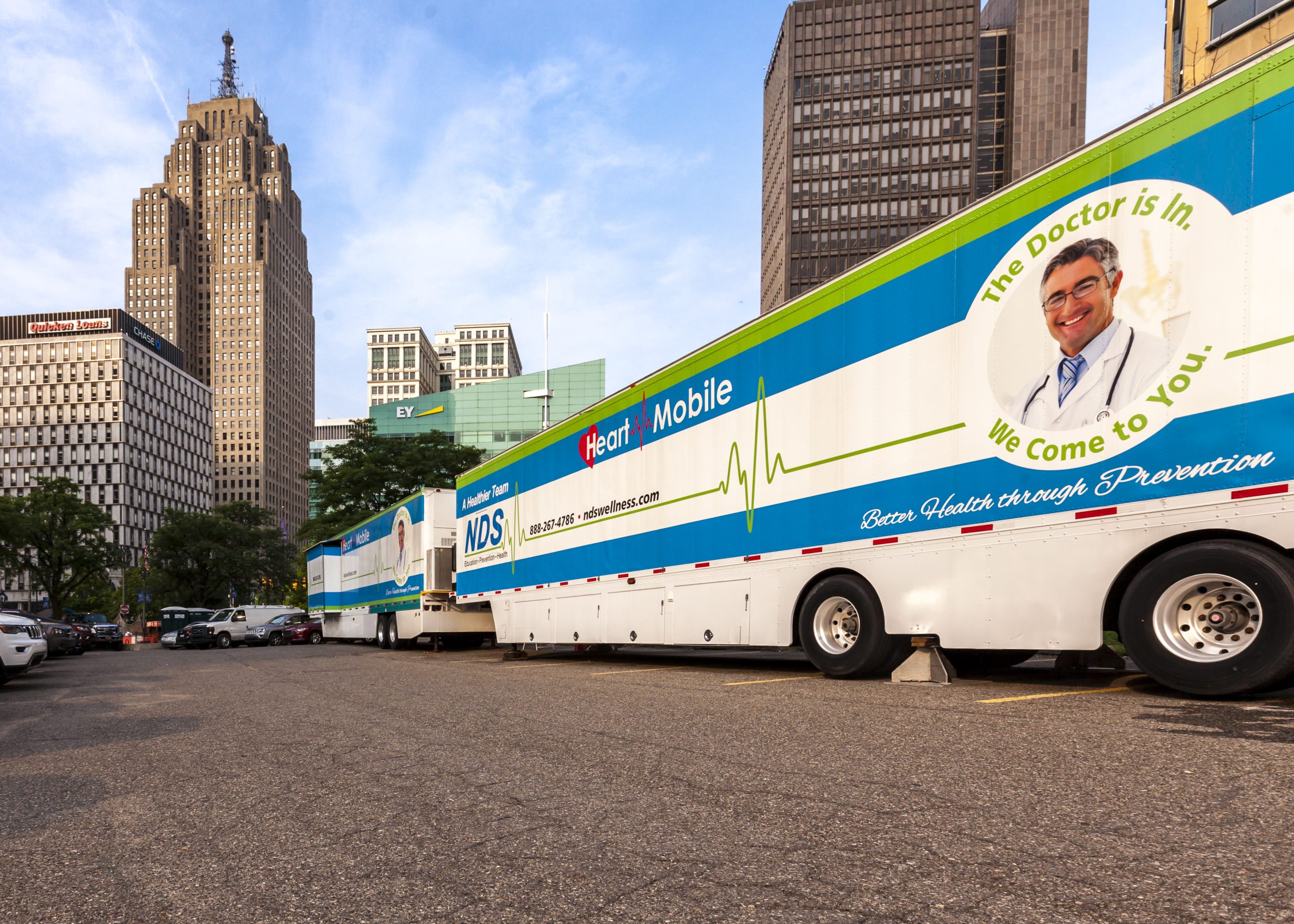
Because we arrive in a mobile wellness clinic, testing happens at your department across every watch, so officers are not asked to give up a day off to be evaluated. Results stay confidential between the officer and the clinician, and follow-up care is coordinated when something needs attention. For the broader picture on why this matters, see our breakdown of the police officer mortality rate research.
Sources
- Kaminsky LA, Arena R, Myers J. “Reference Standards for Cardiorespiratory Fitness Measured With Cardiopulmonary Exercise Testing: Data From the Fitness Registry and the Importance of Exercise National Database (FRIEND).” Mayo Clinic Proceedings, 2015;90(11):1515-1523: mayoclinicproceedings.org
- Varvarigou V, Farioli A, Korre M, Sato S, Dahabreh IJ, Kales SN. “Law enforcement duties and sudden cardiac death among police officers in United States: case distribution study.” BMJ, 2014;349:g6534: pubmed.ncbi.nlm.nih.gov/25406189/
- Kaminsky LA, Arena R, Beckie T, et al. “The importance of cardiorespiratory fitness in the United States: the need for a national registry.” American Heart Association policy statement, Circulation, 2013;127(5)
- Harvard School of Public Health, “Police at higher risk of sudden cardiac death during stressful duties”: news.harvard.edu/gazette